| B |  |
| GO TO DTC CHART (Click here) |
ECD SYSTEM (for i-ART) > Lack of Power or Hesitation |
| Malfunction Condition | Main Trouble Area | Related Trouble Area |
| (a) Injector assembly malfunctions
|
|
| Faults and Symptoms of Common Rail Diesel Components |
Engine Control
| Main fault | Decrease in performance (foreign matter is stuck) |
| Symptoms | Lack of power, black smoke |
| Data List | MAF |
| |
| Symptom and Corresponding Main Fault |
|
| Data List |
|
| Main fault |
|
| Symptoms | Lack of power (when vehicle is starting, under heavy load) (Black smoke is not emitted when racing while vehicle is stopped) |
| Data List | MAP, Target Booster Pressure
|
| Main fault | Blockage |
| Symptoms | Lack of power (high engine speed, under heavy load) |
| Data List | MAP, Target Booster Pressure When the accelerator is fully depressed, if MAP is 20 kPa lower than Target Booster Pressure for more than 5 seconds, then a lack of power will be felt. |
| Main fault | Glow system malfunction |
| Symptoms | Difficult to start, rough idle, knocking, white smoke (when cold) |
| Data List | Check the glow plug indicator light |
| Diagnostic Point | Measure the resistance of the glow plug |
| Main fault | Damaged, seized up |
| Symptoms | Cannot crank, crank speed is low, strange noise |
| Main fault | Loss of compression |
| Symptoms | Rough idle (lack of power always) |
| Data List | Engine Speed of Cyl#
|
Diesel Injection
| Main fault | - |
| Symptoms | Difficult to start, engine stalling, rough idle, lack of power |
| Data List | Fuel Press, Target Common Rail Pressure, Target Pump SCV Current
|
| Diagnostic Trouble Code | Even if Fuel Press is below Target Common Rail Pressure, a DTC will not be stored. |
| Main fault | Blockage |
| Symptoms | Difficult to start, engine stalling, rough idle, lack of power |
| Data List | Fuel Press, Target Common Rail Pressure
|
| Diagnostic Trouble Code | Even if Fuel Press is below Target Common Rail Pressure, a DTC will not be stored. |
| Main fault | Blockage |
| Symptoms | Rough idle, lack of power, black smoke, white smoke, knocking |
| Data List | Injection Feedback Val
|
| Main fault | Circuit fault: The injector assembly does not open. |
| Symptoms | Difficult to start, rough idle, lack of power, black smoke, white smoke, knocking |
| Data List | Same as injector assembly |
| Diagnostic Trouble Code | When the injector driver has a fault, some DTCs may be stored. |
| Main fault | Open circuit, decrease in performance (foreign matter is stuck) |
| Symptoms | Difficult to start, rough idle, engine stall, lack of power |
| Data List | Fuel Press, Target Common Rail Pressure
|
| Diagnostic Code | When the fuel pressure sensor has a fault, some DTCs may be stored. |
| Main fault | - |
| Symptoms | Difficult to start, rough idle (especially when cold) |
Diesel EGR
| Main fault |
|
| Symptoms |
|
| Data List | Actual EGR Valve Pos., Target EGR Position
|
Diesel Throttle
| Main fault | Stuck, does not move smoothly |
| Symptoms |
|
| Data List |
|
| Data List Related to Lack of Power |
| Explanation of Symptom |
| Lack of Power | The power of the diesel engine is determined by the quantity of injected fuel and the quantity of intake air. The quantity of injected fuel is determined by the fuel pressure and the amount of time the injector assembly is open. Basically, the fuel pressure is controlled so that it reaches the target fuel pressure. The throttle valve does not restrict air flow volume, so the manifold absolute pressure is almost the same as atmospheric pressure when idling. At more than approximately 1500 rpm, the turbo starts to operate causing the manifold absolute pressure to become higher than atmospheric pressure. The manifold absolute pressure is controlled so that it reaches the Target Booster Pressure when accelerating the vehicle at full throttle. Also, when accelerating the vehicle at full throttle, the throttle is fully open and the EGR valve is fully closed, preserving the mass air flow. |
| 1.READ OUTPUT DTC (RELATING TO ENGINE) |
Connect the GTS to the DLC3.
Turn the ignition switch to ON and turn the GTS on.
Enter the following menus: Powertrain / Engine / Trouble Codes.
Read the pending DTCs.
| Result | Proceed to |
| No DTCs are output | A |
| Engine related DTCs are output | B |
|
| ||||
| A | |
 |
| 2.TAKE SNAPSHOT DURING IDLING AND 4000 RPM (PROCEDURE 2) |
Connect the GTS to the DLC3.
Start the engine and turn the GTS on.
Enter the following menus: Powertrain / Engine / Data List / Lack of power.
With no load after the engine is warmed up, take a snapshot when idling and at 4000 rpm.
| NEXT | |
|
| 3.TAKE SNAPSHOT DURING LACK OF POWER (PROCEDURE 3) |
Connect the GTS to the DLC3.
Start the engine and turn the GTS on.
Enter the following menus: Powertrain / Engine / Data List / All Data.
Check for a lack of power during the driving test.
| Result | Proceed to |
| Apparent lack of power is present | A |
| Apparent lack of power is not present | B |
|
| ||||
| A | |
|
| 4.CHECK SNAPSHOT (MAP AND MAF) |
Check MAP and MAF in the snapshot taken in procedure 2 when the engine was running at 4000 rpm with no load.
| Result | Proceed to |
| MAP is 105 kPa or higher and MAF is 84 gm/s or more*1 | A |
| MAP is below 90 kPa*2 | B |
| Except above*3 | C |
|
| ||||
|
| ||||
| A | |
|
| 5.CHECK SNAPSHOT (FUEL PRESS, TARGET COMMON RAIL PRESSURE, MAP AND TARGET BOOSTER PRESSURE) |
Check Fuel Press, Target Common Rail Pressure, MAP and Target Booster Pressure in the snapshot taken in procedure 3 when the vehicle was accelerating with the accelerator pedal fully depressed in 2nd gear.
| Result | Proceed to |
| MAP is below 190 kPa at an engine speed of 3000 rpm | A |
| Difference between Fuel Press and Target Common Rail Pressure is 20000 kPa or more | B |
| Except above | C |
|
| ||||
|
| ||||
| A | |
|
| 6.CHECK INTAKE SYSTEM |
Check for air leaks and blockages between the air cleaner case and turbocharger, and between the turbocharger and intake manifold.
|
| ||||
| OK | |
|
| 7.CLEAN FUEL FILTER CASE AND REPLACE FUEL FILTER |
Clean the fuel filter case and replace the fuel filter.
| NEXT | |
|
| 8.REPLACE INJECTOR ASSEMBLY OF ALL CYLINDERS |
Replace the injector assemblies (Click here).
| NEXT | |
|
| 9.BLEED AIR FROM FUEL SYSTEM |
Bleed the air from the fuel system .
| NEXT | |
|
| 10.CONFIRM WHETHER MALFUNCTION HAS BEEN SUCCESSFULLY REPAIRED |
| NEXT | ||
 | ||
| ||
| 11.READ VALUE USING GTS (MAP AND ATMOSPHERIC PRESSURE) |
Connect the GTS to the DLC3.
Turn the ignition switch to ON and turn the GTS on.
Enter the following menus: Powertrain / Engine / Data List / MAP and Atmosphere Pressure.
Compare MAP to Atmosphere Pressure when the ignition switch is turned to ON (do not start the engine).
| Result | Proceed to |
| MAP and Atmosphere Pressure have same value | A |
| MAP is different from actual atmospheric pressure | B |
| Atmosphere Pressure is different from actual atmospheric pressure | C |
|
| ||||
|
| ||||
| A | |
|
| 12.CHECK AIR INTAKE SYSTEM |
Check for air leaks and blockages between the air cleaner case and turbocharger, and between the turbocharger and intake manifold.
| Result | Proceed to |
| Leaks and/or blockages exist in the intake system | A |
| No leaks or blockages in the intake system | B |
|
| ||||
| B | |
|
| 13.CHECK TURBOCHARGER SUB-ASSEMBLY |
Check for turbocharger sub-assembly (Click here).
|
| ||||
| OK | |
|
| 14.CHECK FOR INTERMITTENT PROBLEMS |
Check for intermittent problems (Click here).
|
| ||||
| 15.REPLACE MANIFOLD ABSOLUTE PRESSURE SENSOR |
Replace the manifold absolute pressure sensor.
|
| ||||
| 16.REPLACE ECM |
Replace the ECM (Click here).
|
| ||||
| 17.REPAIR OR REPLACE AIR INTAKE SYSTEM |
Repair or replace the malfunctioning part in the air intake system.
|
| ||||
| 18.REPLACE TURBOCHARGER SUB-ASSEMBLY |
Replace the turbocharger sub-assembly (Click here).
| NEXT | |
|
| 19.CONFIRM WHETHER MALFUNCTION HAS BEEN SUCCESSFULLY REPAIRED |
| NEXT | ||
| ||
| ||
| 20.INSPECT CLOGGED FUEL PIPE |
Connect the GTS to the DLC3.
Start the engine and turn the GTS on.
Enter the following menus: Powertrain / Engine / Data List / Diesel Injection.
With no load after the engine is warmed up, take a snapshot when idling and while the vehicle is accelerating with the accelerator pedal fully depressed in 2nd gear.
Check the Target Common Rail Pressure and Fuel Press value.
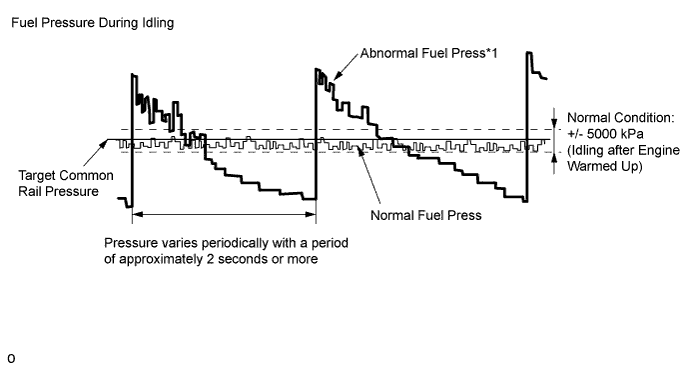
| Result | Proceed to |
| While idling the vehicle, "Fuel Press" deviates from the normal range and varies periodically with a period of approximately 2 seconds or more*1 | A |
| "Fuel Press" is normal while idling the vehicle, but "Fuel Press" does not follow "Target Common Rail Pressure" when the accelerator pedal is fully depressed in 2nd gear*2 | |
| Except above | B |
|
| ||||
| B | |
|
| 21.REPLACE FUEL SUPPLY PUMP ASSEMBLY (SUCTION CONTROL VALVE) |
Replace the fuel supply pump assembly (Click here).
|
| ||||
| 22.REPAIR OR REPLACE CLOGGED FUEL LINE |
Repair or replace the clogged (including frozen fuel) fuel pipe.
Replace the fuel filter element sub-assembly.
| NEXT | |
|
| 23.BLEED AIR FROM FUEL SYSTEM |
Bleed the air from the fuel system .
| NEXT | |
|
| 24.PERFORM SUPPLY PUMP INITIALIZATION |
Perform supply pump initialization (Click here).
| NEXT | |
|
| 25.CONFIRM WHETHER MALFUNCTION HAS BEEN SUCCESSFULLY REPAIRED |
Connect the GTS to the DLC3.
Start the engine and turn the GTS on.
Enter the following menus: Powertrain / Engine / Active Test / Test the Fuel Leak / Data List / Fuel Press, Target Common Rail Pressure.
Take a snapshot with the GTS during the Active Test.
Measure the difference between the target fuel pressure (Target Common Rail Pressure) and the actual fuel pressure (Fuel Press) when the "Test the Fuel Leak" Active Test is performed.
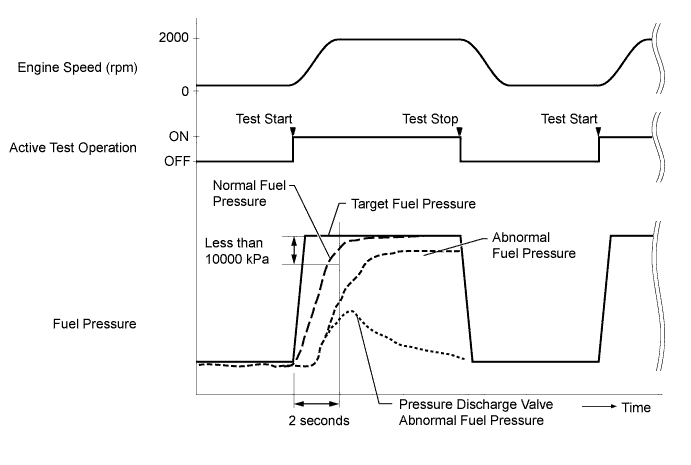
| NEXT | ||
| ||
| ||
| 26.CHECK AIR INTAKE SYSTEM |
Check for air leaks and blockages between the air cleaner case and turbocharger, and between the turbocharger and intake manifold.
| Result | Proceed to |
| No leaks or blockages in the intake system | A |
| Leaks and/or blockages exist in the intake system | B |
|
| ||||
| A | |
|
| 27.PERFORM ACTIVE TEST USING GTS (ACTIVATE THE EGR VALVE CLOSE) |
Connect the GTS to the DLC3.
Start the engine and warm it up, and make sure the A/C switch and all accessory switches are off.
Turn the ignition switch off. Wait for 30 seconds, and then restart the engine.
Turn the GTS on.
Enter the following menus: Powertrain / Engine / Data List / MAF.
Read the MAF value displayed on the GTS while the engine is idling.
Enter the following menus: Powertrain / Engine / Active Test / Activate the EGR Valve Close.
Read the MAF value when the EGR valve is closed using the Active Test function.
| Active Test | Result | Proceed to |
| Activate the EGR Valve Close: Off (Open) to On (Closed) | MAF value does not change | A |
| MAF value changes | B |
| EGR Valve Condition (Opening) | Measuring Condition | MAF (Reference) |
| Open (55%) |
| 3 to 10 gm/s |
| Closed (0%) | 12 to 21 gm/s |
|
| ||||
| A | |
|
| 28.READ VALUE USING GTS (MAF) |
Connect the GTS to the DLC3.
Turn the ignition switch to ON and turn the GTS on.
Enter the following menus: Powertrain / Engine / Data List / MAF.
Read the value.
| Tester Display | Condition | Specified Condition |
| MAF | Engine not running | Less than 0.35 gm/s |
|
| ||||
| OK | |
|
| 29.PERFORM ACTIVE TEST USING GTS (ACTIVATE THE VSV FOR EGR COOLER BYPASS) |
Connect the GTS to the DLC3.
Start the engine and warm it up, and make sure the A/C switch and all accessory switches are off.
Turn the ignition switch off and wait for 30 seconds.
Start the engine and turn the GTS on.
Enter the following menus: Powertrain / Engine / Data List / MAF.
Read the MAF value displayed on the GTS while the engine is idling.
Enter the following menus: Powertrain / Engine / Active Test / Activate the VSV for EGR Cooler Bypass / Data List / EGR Cooler Bypass Position.
Using the Active Test function, switch the EGR valve bypass switching valve between "Cooler" and "Bypass" a few times, and then check whether the MAF value changes after switching the valve from "Cooler" to "Bypass".
| Tester Display | Result | Proceed to |
| Activate the VSV for EGR Cooler Bypass: Cooler to Bypass | MAF value does not change | A |
| MAF value changes | B |
|
| ||||
| A | |
|
| 30.REMOVE DEPOSIT (ELECTRIC EGR CONTROL VALVE ASSEMBLY) |
Remove the electric EGR control valve assembly (Click here).
Visually check the electric EGR control valve assembly for deposits.
If there are deposits, clean the electric EGR control valve assembly.
Reinstall the electric EGR control valve assembly (Click here).
|
| ||||
| 31.REPAIR OR REPLACE AIR INTAKE SYSTEM |
Repair or replace the malfunctioning part in the air intake system.
|
| ||||
| 32.REPLACE MASS AIR FLOW METER |
Replace the mass air flow meter (Click here).
|
| ||||
| 33.REPLACE EGR COOLER |
Replace the EGR cooler (Click here).
| NEXT | |
|
| 34.CONFIRM WHETHER MALFUNCTION HAS BEEN SUCCESSFULLY REPAIRED |
|
| ||||
| OK | ||
| ||
| ||
| 35.PERFORM ACTIVE TEST USING GTS (ACTIVATE THE VSV FOR EGR COOLER BYPASS) |
Connect the GTS to the DLC3.
Start the engine and warm it up, and make sure the A/C switch and all accessory switches are off.
Turn the ignition switch off and wait for 30 seconds.
Start the engine and turn the GTS on.
Enter the following menus: Powertrain / Engine / Data List / MAF.
Read the MAF value displayed on the GTS while the engine is idling.
Enter the following menus: Powertrain / Engine / Active Test / Activate the VSV for EGR Cooler Bypass / Data List / EGR Cooler Bypass Position.
Using the Active Test function, switch the EGR valve bypass switching valve between "Cooler" and "Bypass" a few times, and then check whether the MAF value changes after switching the valve from "Cooler" to "Bypass".
| Tester Display | Result | Proceed to |
| Activate the VSV for EGR Cooler Bypass: Cooler to Bypass | MAF value does not change | A |
| MAF value changes | B |
|
| ||||
| A | |
|
| 36.CHECK FRONT EXHAUST PIPE ASSEMBLY (CATALYST CONVERTER) |
Remove the front exhaust pipe assembly (Click here).
Visually check for catalyst clogging or carbon deposits adhering to the inner wall of the exhaust pipe upstream of the catalyst.
Reinstall the front exhaust pipe assembly (Click here).
|
| ||||
| OK | |
|
| 37.INSPECT TURBOCHARGER SUB-ASSEMBLY |
Inspect the turbocharger sub-assembly (Click here).
|
| ||||
| OK | |
|
| 38.CHECK FOR INTERMITTENT PROBLEMS |
Check for intermittent problems (Click here).
|
| ||||
| 39.REPLACE EGR COOLER |
Replace the EGR cooler (Click here).
|
| ||||
| 40.REPLACE FRONT EXHAUST PIPE ASSEMBLY (CATALYST CONVERTER) |
Replace the front exhaust pipe assembly (Click here).
|
| ||||
| 41.REPLACE TURBOCHARGER SUB-ASSEMBLY |
Replace the turbocharger sub-assembly (Click here).
| NEXT | |
|
| 42.CONFIRM WHETHER MALFUNCTION HAS BEEN SUCCESSFULLY REPAIRED |
| NEXT | ||
| ||
| ||
| 43.COMPARE WITH SIMILAR VEHICLE WITH SAME ENGINE |
Confirm the situation in which the lack of power was experienced by the customer again, and compare the driving feeling under the same conditions using a similar vehicle with the same engine while collecting data with the GTS.
| Result | Proceed to |
| Significant difference is found | A |
| Significant difference is not found | B |
|
| ||||
| B | |
|
| 44.EXPLAIN THE INVESTIGATION RESULT TO CUSTOMER |
Vehicle performance is normal.
There is no problem at this point in time. However, if the problem reoccurs, ask the customer to explain in detail the situation in which the problem reoccurs.
The best course may be to have the customer ride in another vehicle with the same specifications to understand that there is no problem with the customer's vehicle.
| NEXT | ||
| ||
| ||
