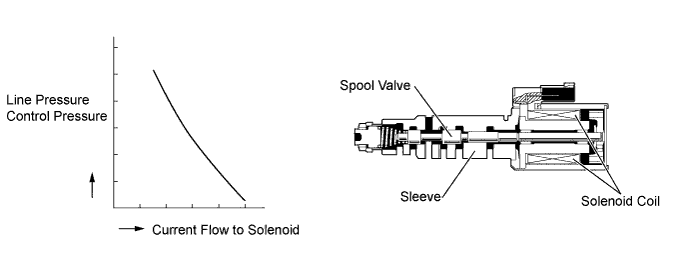
DTC P2714 Pressure Control Solenoid "D" Performance (Shift Solenoid Valve SLT) |
| DTC No. | DTC Detection Condition | Trouble Area |
| P2714 | ECM detects a malfunction with the solenoid valve SLT (ON side) according to difference in revolutions of turbine (input) and output shaft (2 trip detection logic) |
|
| Related DTCs | P2714: Shift solenoid valve SLT/ON malfunction |
| Required sensors/Components | Shift solenoid valve SLT, Speed sensor (NT), Speed sensor (SPD) |
| Frequency of operation | Continuous |
| Duration | 1 second |
| MIL operation | 2 driving cycles |
| Sequence of operation | None |
| The monitor will run whenever the following DTCs are not present | P0973, P0974 (Shift solenoid valve S1 circuit) P0976, P0977 (Shift solenoid valve S2 circuit) P0128 (ECT (Engine coolant temperature) sensor circuit) P0722 (Output speed sensor circuit) P0500 (Vehicle speed sensor circuit) P2759 (Torque converter clutch pressure control solenoid circuit) P2716 (Pressure control solenoid (SLT) circuit) |
| Transmission range | "D" |
| Duration time from shifting "N" to "D" | 4 seconds or more |
| ECT (Engine Coolant Temperature) | 40°C (104°F) or more |
| Spark advance from max. retard timing by knock control | 0°CA or more |
| Engine | Starting |
| ATF (Automatic Transmission Fluid) temperature | -10°C (14°F) or more |
| ETCS (Electronic Throttle Control System) | Not system down |
| ECM selected gear | 1st, 2nd or 3rd |
| Input speed | 300 rpm or more |
| Output speed | 300 rpm or more |
| ECM selected gear | 4th |
| Duration | 0.85 seconds or more |
| Input speed - Output speed x ECM selected gear ratio (1st to 3rd) | More than 350 rpm at output speed 1000 rpm (Conditions vary with intermediate shaft speed) |
| Duration | 0.85 seconds or more |
| Input speed (4th) | 300 rpm or more |
| ACTIVE TEST |
Warm up the engine.
Turn the ignition switch off.
Connect Techstream to the DLC3.
Turn the ignition switch to ON.
Turn the Techstream on.
Enter the following menus: Powertrain / Engine and ECT / Active Test.
Follow the instructions on the Techstream and perform the Active Test.
| Tester Display | Test Part | Control Range | Diagnostic Note |
| Activate the Solenoid (SLT)* | Operate the shift solenoid SLT and raise line pressure | ON or OFF
| [Vehicle Condition]
|
| 1.CHECK DTC OUTPUT (IN ADDITION TO DTC P2714) |
Connect Techstream to the DLC3.
Turn the ignition switch to ON.
Turn the Techstream on.
Enter the following menus: Powertrain / Engine and ECT / Trouble Codes.
Read the DTCs using Techstream.
| Result | Proceed to |
| Only P2714 is output | A |
| P2714 and other DTCs are output | B |
|
| ||||
| A | |
 |
| 2.INSPECT SHIFT SOLENOID VALVE SLT |
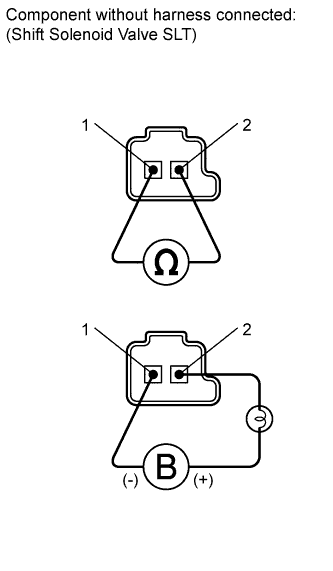 |
Remove the shift solenoid valve SLT.
Measure the resistance of the solenoid valve.
| Tester Connection | Condition | Specified Condition |
| 1 - 2 | 20°C (68°F) | 5.0 to 5.6 Ω |
Connect the battery's positive (+) lead with a 21 W bulb to terminal 2 and the negative (-) lead to terminal 1 of the solenoid valve connector. Then check that the valve moves and makes an operating noise.
|
| ||||
| OK | |
|
| 3.INSPECT TRANSMISSION VALVE BODY ASSEMBLY |
Check the transmission valve body assembly (Click here).
|
| ||||
| OK | |
|
| 4.INSPECT TORQUE CONVERTER ASSEMBLY |
Check the torque converter assembly (Click here).
|
| ||||
| OK | ||
 | ||
| ||
