P1229 Fuel Pump System
Diagnostic trouble codes · Vehicles built from Nov 2005
Also covers:
- P1272 Fuel Pressure Regulator System Malfunction
DESCRIPTION
Refer to DTC P0089 (Click here) and DTC P0252 (Click here).| DTC No. |
DTC Detection Conditions |
Trouble Areas |
| P1229 |
When common rail internal pressure is regulated using fuel metering unit, it does not reach target pressure level or it exceeds target level by too much (The MIL is illuminated and a DTC is immediately set when a malfunction is detected) |
|
| P1272 |
When common rail internal pressure is regulated using pressure control valve, it does not reach target pressure level or it exceeds target level by too much (The MIL is illuminated and a DTC is immediately set when a malfunction is detected) |
- HINT:
- DTC P1229 is set when the vehicle is driven (including acceleration and deceleration) at a vehicle speed of over 50 km/h (31 mph) for more than 5 minutes, while the fuel temperature is more than 10°C (50°F) and the engine coolant temperature is higher than the fuel temperature.
- DTC P1272 is set when the vehicle is driven (including acceleration and deceleration) at a vehicle speed of over 50 km/h (31 mph) for more than 5 minutes, while the fuel temperature is more than 10°C (50°F) and the engine coolant temperature is higher than the fuel temperature.
- DTCs P1229 and/or P1272 may be set if the vehicle is driven with insufficient fuel.
- With cold engine, the internal pressure of the common rail is regulated by the pressure control valve.
With warm engine, it is regulated by the fuel metering unit.
- When DTC P1229 and/or P1272 is set, check the internal fuel pressure of the common rail by selecting the following menu items on the intelligent tester: Powertrain / Engine and ECT / Data List / Common Rail Pressure.
- DTC P1229 is set when the vehicle is driven (including acceleration and deceleration) at a vehicle speed of over 50 km/h (31 mph) for more than 5 minutes, while the fuel temperature is more than 10°C (50°F) and the engine coolant temperature is higher than the fuel temperature.
- Reference:
Engine Speed
Fuel Pressure (MPa)
Idling
Approximately 25 to 36
2,000 rpm (No engine load)
Approximately 27 to 46
3,000 rpm (No engine load)
Approximately 34 to 69
WIRING DIAGRAM
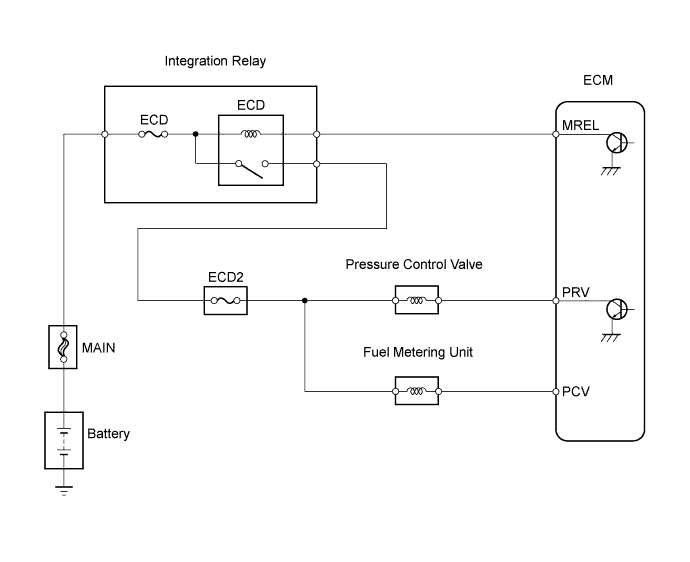

INSPECTION PROCEDURE
- HINT:
- Read freeze frame data using an intelligent tester. Freeze frame data record the engine condition when malfunctions are detected. When troubleshooting, freeze frame data can help determine if the vehicle was moving or stationary, if the engine was warmed up or not, if the air-fuel ratio was lean or rich, and other data, from the time the malfunction occurred.
| 1. CHECK ANY OTHER DTCS OUTPUT (IN ADDITION TO DTC P1229 AND/OR P1272) |

Connect an intelligent tester to the DLC3.
Turn the ignition switch on (IG) and turn the tester on.
Select the following menu items: Powertrain / Engine and ECT / DTC.
Read DTCs.
- Result:
Display (DTC Output)
Proceed To
P1229 and/or P1272
A
P1229 and/or P1272 and other DTCs
B
|
|
||||

| A | |
 |
| 2. PERFORM ACTIVE TEST USING INTELLIGENT TESTER (FUEL LEAK TEST) |
Connect an intelligent tester to the DLC3.
Start the engine and turn the tester on.
Select the following menu items: Powertrain / Engine and ECT / Active Test / Fuel leak test.
Visually check the supply pump, injector and fuel line located between the supply pump and common rail for fuel leaks. Also, perform the same check on the fuel line between the common rail and the injector
- HINT:
- There may be fuel leaks inside the components, such as the supply pump.
- OK:
- No leakage.
|
|
||||
| OK | |
|
| 3. CHECK COMMON RAIL SYSTEM (FUEL BLOCKAGES) |
Check for any fuel blockages between the fuel filter and injector.
- OK:
- No malfunctions.
|
|
||||
| OK | |
|
| 4. CONFIRM IF VEHICLE HAS RUN OUT OF FUEL IN PAST |
Ask the customer whether the fuel has run out recently.
Ask the customer whether repetitive quick turns were made while the fuel was low.
Result
Proceed To
- Fuel not run out recently
- Quick turns not repeated when fuel low
A
- Fuel run out recently
- Quick turns repeated when fuel low
B
- Fuel not run out recently
|
|
||||
| A | |
|
| 5. INSPECT COMMON RAIL ASSEMBLY (PRESSURE CONTROL VALVE ASSEMBLY) |
Disconnect the C53 pressure control valve connector.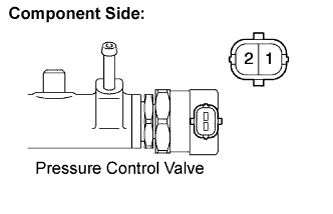
Measure the resistance between the terminals of the pressure control valve.
- Standard resistance:
- 3.42 to 3.78 Ω at 20°C (68°F)
Reconnect the pressure control valve connector.
|
|
||||
| OK | |
|
| 6. CHECK HARNESS AND CONNECTOR (ECM - PRESSURE CONTROL VALVE - ECD RELAY) |
Disconnect the C53 pressure control valve connector.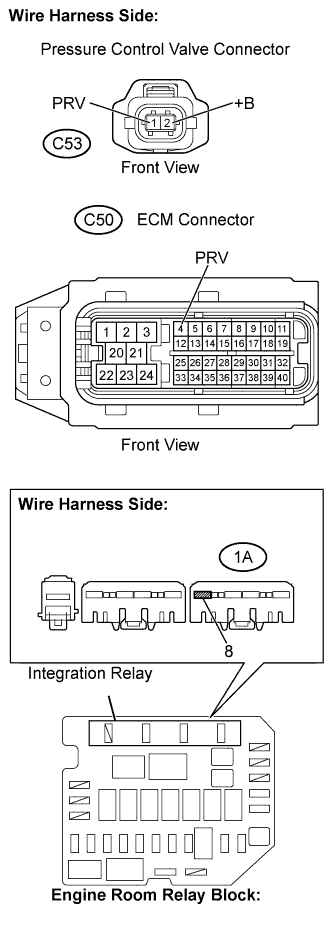
Disconnect the C50 ECM connector.
Remove the integration relay from the engine room relay block.
Check the resistance.
- Standard resistance (Check for open):
Tester Connections
Specified Conditions
PRV (C50-4) - PRV (C53-1)
Below 1 Ω
Integration relay (1A-8) - +B (C53-2)
- Standard resistance (Check for short):
Tester Connections
Specified Conditions
PRV (C50-4) or PRV (C53-1) - Body ground
10 kΩ or higher
Integration relay (1A-8) or +B (C53-2) - Body ground
Reconnect the pressure control valve connector.
Reconnect the ECM connector.
Reinstall the integration relay.
|
|
||||
| OK | |
|
| 7. INSPECT SUPPLY PUMP ASSEMBLY (FUEL METERING UNIT) |
Disconnect the C54 fuel metering unit connector.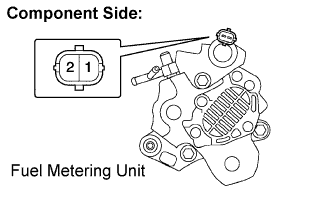
Measure the resistance between the terminals of the fuel metering unit valve.
- Standard resistance:
- 2.60 to 3.15 Ω at 20°C (68°F)
Reconnect the fuel metering unit connector.
|
|
||||
| OK | |
|
| 8. CHECK HARNESS AND CONNECTOR (ECD RELAY - FUEL METERING UNIT - ECM) |
Disconnect the C54 fuel metering unit connector.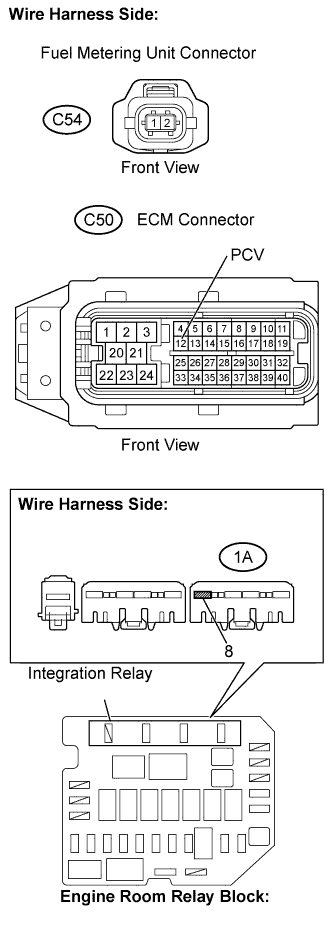
Disconnect the C50 ECM connector.
Remove the integration relay from the engine room relay block.
Check the resistance.
- Standard resistance (Check for open):
Tester Connections
Specified Conditions
(C54-1) - Integration relay (1A-8)
Below 1 Ω
PCV (C50-12) - (C54-2)
- Standard resistance (Check for short):
Tester Connections
Specified Conditions
(C54-1) or Integration relay (1A-8) - Body ground
10 kΩ or higher
PCV (C50-12) or (C54-2) - Body ground
Reinstall the integration relay.
Reconnect the ECM connector.
Reconnect the fuel metering unit connector.
|
|
||||
| OK | |
|
| 9. REPLACE COMMON RAIL ASSEMBLY (PRESSURE CONTROL VALVE) |
| NEXT | |
|
| 10. CHECK WHETHER DTC OUTPUT RECURS (DTC P1229 AND/OR P1272) |
Connect an intelligent tester to the DLC3.
Turn the ignition switch on (IG) and turn the tester on.
Clear DTCs (Click here).
Drive the vehicle at 50 km/h (31 mph) for more than 5 minutes while the fuel temperature is more than 10°C (50°F).
Drive the vehicle at 50 km/h (31 mph) for more than 5 minutes while the fuel temperature is less than 10°C (50°F).
Select the following menu items: Powertrain / Engine and ECT / DTC.
Read DTCs.
- Result:
Display (DTC Output)
Proceed To
P1229 and/or P1272
A
No output
B
|
|
||||
| A | |
|
| 11. REPLACE SUPPLY PUMP ASSEMBLY (FUEL METERING UNIT) |
| NEXT | |
|
| 12. CHECK WHETHER DTC OUTPUT RECURS (DTC P1229 AND/OR P1272) |
Connect an intelligent tester to the DLC3.
Turn the ignition switch on (IG) and turn the tester on.
Clear DTCs (Click here).
Drive the vehicle at 50 km/h (31 mph) for more than 5 minutes while the fuel temperature is more than 10°C (50°F).
Drive the vehicle at 50 km/h (31 mph) for more than 5 minutes while the fuel temperature is less than 10°C (50°F).
Select the following menu items: Powertrain / Engine and ECT / DTC.
Read DTCs.
- Result:
Display (DTC Output)
Proceed To
P1229 and/or P1272
A
No output
B
|
|
||||
| A | ||
 |
||
| ||