POWER ASSIST SYSTEMS VANE PUMP(for 1VD-FTV) ON-VEHICLE INSPECTION
PROCEDURE

 1.CHECK STEERING EFFORT
- CAUTION:
-
These service operations may affect the SRS airbags. Be sure to read the precautionary notices concerning the SRS airbag system before servicing.
-
(See page Vehicle Interior>SUPPLEMENTAL RESTRAINT SYSTEMS>AIRBAG SYSTEM>PRECAUTION)
Stop the vehicle on a level, paved surface and align the wheels straight ahead.
Remove the steering pad assembly.
(See page Vehicle Interior>SUPPLEMENTAL RESTRAINT SYSTEMS>STEERING PAD>REMOVAL)
Connect the cable to the negative (-) battery terminal.
Using a torque wrench, check that the steering wheel set nut is properly tightened.
(See page Steering>STEERING COLUMN>STEERING WHEEL>INSTALLATION)
Start the engine so that the power steering is ready to operate.
Turn the steering wheel 90 degrees to the right and check the steering effort (torque) while continuing to turn it further in the same direction.
- Standard steering effort (Reference)::
6.0 N*m (61 kgf*cm, 53 in.*lbf) or less
Align the front wheels facing straight ahead.
Turn the engine switch off.
Disconnect the cable from the negative (-) battery terminal.
Install the steering pad assembly.
(See page Vehicle Interior>SUPPLEMENTAL RESTRAINT SYSTEMS>STEERING PAD>INSTALLATION)
2.BLEED POWER STEERING SYSTEM
Check the fluid level.
Jack up the front of the vehicle and support it with stands.
Turn the steering wheel.
With the engine stopped, turn the wheel slowly from lock to lock several times.
Lower the vehicle.
Start the engine.
Idle the engine for a few minutes.
Turn the steering wheel.
With the engine idling, turn the wheel left or right to the full lock position and keep it there for 2 to 3 seconds, then turn the wheel to the opposite full lock position and keep it there for 2 to 3 seconds. *1
Repeat *1 several times.
- NOTICE:
-
For vehicles with VGRS, if the steering wheel is turned from lock to lock repeatedly, the system may stop operating and the amount of rotation before the steering wheel locks may increase due to operation of the overheating prevention function. When the system temperature drops, the system operation automatically returns to normal.
Stop the engine.
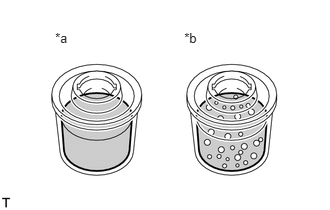
Check for foaming or emulsification.
| *a | Correct |
| *b | Incorrect |
If the system has to be bled twice because of foaming or emulsification, check for fluid leaks in the system.
Check the fluid level.
3.CHECK FLUID LEVEL
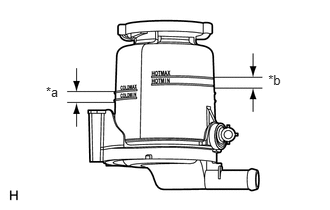
Keep the vehicle horizontal.
| *a | COLD Range |
| *b | HOT Range |
With the engine stopped, check the fluid level in the reservoir.
If necessary, add fluid.
- Fluid:
ATF DEXRON II or III, or equivalent
- HINT:
-
If the fluid is hot, check that the fluid level is within the HOT range. If the fluid is cold, check that the fluid level is within the COLD range.
Start the engine and idle it.
Turn the steering wheel from lock to lock several times to raise the fluid temperature.
- Fluid temperature:
80°C (176°F)
Check for foaming or emulsification.
| *a | Correct |
| *b | Incorrect |
If foaming or emulsification is identified, bleed the power steering system.
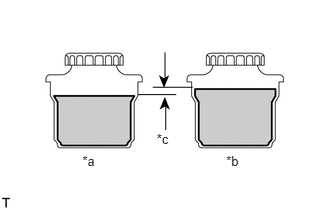
With the engine idling, measure the fluid level in the reservoir.
| *a | Engine idling |
| *b | Engine stopped |
| *c | 5.0 mm (0.197 in.) or less |
Stop the engine.
Wait a few minutes and remeasure the fluid level in the reservoir.
- Maximum fluid level rise:
5.0 mm (0.197 in.)
If the fluid level rise is more than the maximum, bleed the power steering system.
Check the fluid level.
4.CHECK STEERING FLUID PRESSURE
Disconnect the pressure feed tube from the vane pump.
w/o Variable Flow Control Solenoid Valve:
Refer to the following procedures (See page Steering>POWER ASSIST SYSTEMS>VANE PUMP (for 1VD-FTV)>REMOVAL).
w/ Variable Flow Control Solenoid Valve:
Refer to the following procedures (See page Steering>POWER ASSIST SYSTEMS>VANE PUMP (for 1VD-FTV)>REMOVAL).
Connect SST as shown in the illustration.
- SST
- 09640-10011 (09641-01010, 09641-01030, 09641-01060, 09641-01040, 09641-01070)
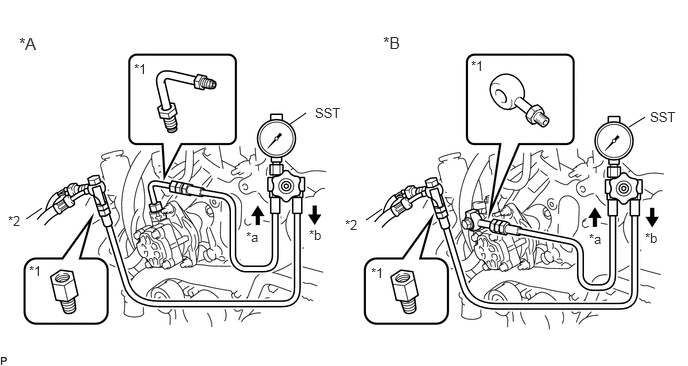
| *A | w/o Variable flow control solenoid valve | *B | w/ Variable flow control solenoid valve |
| *1 | Attachment | *2 | Pressure feed tube |
| *a | IN | *b | OUT |
- NOTICE:
-
Make sure that the valve of SST is in the open position.
Bleed the power steering system.
Start the engine and idle it.
Turn the steering wheel from lock to lock several times to raise the fluid temperature.
- Fluid temperature:
80°C (176°F)
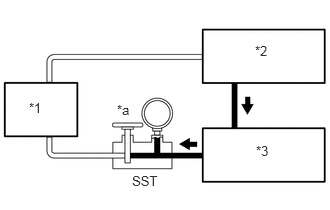
With the engine idling, close the valve of SST and observe the reading on SST.
| w/o Variable Flow Control Solenoid Valve | except Middle East | 10000 to 10700 kPa (102 to 109 kgf/cm2, 1450 to 1551 psi) |
| for Middle East | 12200 to 13200 kPa (125 to 134 kgf/cm2, 1769 to 1914 psi) | |
| w/ Variable Flow Control Solenoid Valve | except Middle East | 10000 to 10700 kPa (102 to 109 kgf/cm2, 1450 to 1551 psi) |
| for Middle East | 11500 to 12500 kPa (118 to 127 kgf/cm2, 1668 to 1812 psi) |
| *1 | Power steering gear |
| *2 | Oil reservoir |
| *3 | Vane pump |
| *a | Closed |
- NOTICE:
- ·
Do not keep the valve closed for more than 10 seconds.
·Do not allow the fluid temperature to become too high.
If the pressure is less than the minimum, check for fluid leaks and replace parts as necessary.
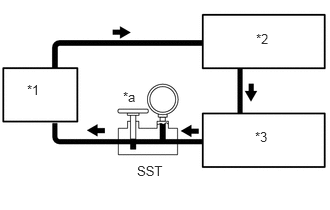
With the engine idling, fully open the valve.
| *1 | Power steering gear |
| *2 | Oil reservoir |
| *3 | Vane pump |
| *a | Open |
Measure the fluid pressure at engine speeds of 1000 rpm and 3000 rpm.
- Difference in fluid pressure:
500 kPa (5.1 kgf/cm2, 73 psi) or less
- NOTICE:
-
Do not turn the steering wheel.
If the pressure difference is higher than the specified value, check for fluid leaks and replace parts as necessary.
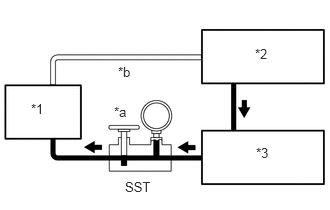
With the engine idling and the valve fully open, turn the steering wheel left or right to the full lock position. Observe the reading on SST.
| *1 | Power steering gear |
| *2 | Oil reservoir |
| *3 | Vane pump |
| *a | Open |
| *b | Lock position |
| w/o Variable Flow Control Solenoid Valve | except Middle East | 10000 to 10700 kPa (102 to 109 kgf/cm2, 1450 to 1551 psi) |
| for Middle East | 12200 to 13200 kPa (125 to 134 kgf/cm2, 1769 to 1914 psi) | |
| w/ Variable Flow Control Solenoid Valve | except Middle East | 10000 to 10700 kPa (102 to 109 kgf/cm2, 1450 to 1551 psi) |
| for Middle East | 11500 to 12500 kPa (118 to 127 kgf/cm2, 1668 to 1812 psi) |
- NOTICE:
- ·
Do not keep the steering wheel in the full lock position for more than 10 seconds.
·Do not allow the fluid temperature to become too high.
If the pressure is less than the minimum, check for fluid leaks and replace parts as necessary.
Disconnect SST.
Connect the pressure feed tube to the vane pump.
w/o Variable Flow Control Solenoid Valve:
Refer to the following procedures (See page Steering>POWER ASSIST SYSTEMS>VANE PUMP (for 1VD-FTV)>INSTALLATION).
w/ Variable Flow Control Solenoid Valve:
Refer to the following procedures (See page Steering>POWER ASSIST SYSTEMS>VANE PUMP (for 1VD-FTV)>INSTALLATION).
Bleed the power steering system.