SEAT BELT SEAT BELT WARNING SYSTEM(w/o Occupant Classification System) Front Passenger Side Seat Belt Warning Light Malfunction
DESCRIPTION
The occupant detection sensor (separate type front seat cushion pad) detects if the passenger seat is occupied and sends signals to the combination meter assembly. The front seat inner belt assembly (front passenger seat) detects the passenger seat belt condition and sends signals to the combination meter assembly. After receiving the signals from the occupant detection sensor (separate type front seat cushion pad) and front seat inner belt assembly (front passenger seat), the seat belt warning light on the combination meter assembly will blink or go off.
WIRING DIAGRAM
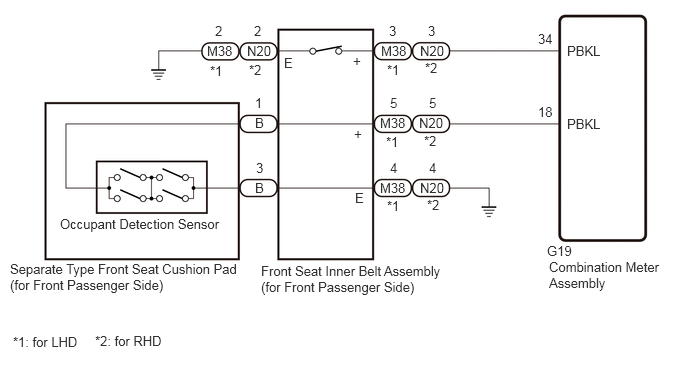
CAUTION / NOTICE / HINT
- NOTICE:
- ·
The seat belt warning system uses the CAN communication system. First, confirm that there are no malfunctions in the CAN communication system. Refer to How to Proceed with Troubleshooting.
·When replacing the combination meter assembly, always replace it with a new one. If a combination meter assembly which was installed to another vehicle is used, the information stored in it will not match the information from the vehicle and a DTC may be stored.
- HINT:
-
The seat belt warning light on the combination meter assembly is used for both the driver seat and front passenger seat. Check that the operation of the seat belt warning light is normal first.
-
If the seat belt warning light does not operate for both the driver seat and front passenger seat, replace the combination meter.
-
Click hereVehicle Interior>METER / GAUGE / DISPLAY>COMBINATION METER>REMOVAL
PROCEDURE
Connect the GTS to the DLC3.
Turn the ignition switch to ON.
Turn the GTS on.
Enter the following menus: Body Electrical / Combination Meter / Data List.
Read the Data List according to the display on the GTS.
- Body Electrical > Combination Meter > Data List
-
Tester Display Measurement Item Range Normal Condition Diagnostic Note Passenger Buckle Switch Front passenger seat belt buckle switch signal OFF or ON OFF: Front passenger seat belt fastened
ON: Front passenger seat belt not fastened- Passenger Occupant Detection Switch Occupant detection sensor signal OFF or ON OFF: Front passenger seat not occupied
ON: Front passenger seat occupied-
- Body Electrical > Combination Meter > Data List
-
Tester Display Passenger Buckle Switch Passenger Occupant Detection Switch - 50003 409 27,28
- OK:
The GTS display changes correctly in response to the front passenger seat belt and front passenger seat condition.
- Result:
Result Proceed to OK A NG (Passenger Occupant Detection Switch) B NG (Passenger Buckle Switch) C
A
B
C
Remove the front seat inner belt assembly (for Front Passenger Side).
for Manual Seat:
Click hereVehicle Interior>SEAT BELT>FRONT SEAT INNER BELT ASSEMBLY (for Manual Seat)>REMOVAL
for Power Seat:
Click hereVehicle Interior>SEAT BELT>FRONT SEAT INNER BELT ASSEMBLY (for Power Seat)>REMOVAL
Inspect the front seat inner belt assembly (for Front Passenger Side).
for Manual Seat:
Click hereVehicle Interior>SEAT BELT>FRONT SEAT INNER BELT ASSEMBLY (for Manual Seat)>INSPECTION
for Power Seat:
Click hereVehicle Interior>SEAT BELT>FRONT SEAT INNER BELT ASSEMBLY (for Power Seat)>INSPECTION
- Result:
Proceed to OK NG
OK
NG
for Manual Seat:
Click hereVehicle Interior>SEAT BELT>FRONT SEAT INNER BELT ASSEMBLY (for Manual Seat)>REMOVAL
for Power Seat:
Click hereVehicle Interior>SEAT BELT>FRONT SEAT INNER BELT ASSEMBLY (for Power Seat)>REMOVAL
Remove the separate type front seat cushion pad (occupant detection sensor).
Click hereVehicle Interior>SEAT BELT>OCCUPANT DETECTION SENSOR>REMOVAL
Inspect the separate type front seat cushion pad (occupant detection sensor).
Click hereVehicle Interior>SEAT BELT>OCCUPANT DETECTION SENSOR>INSPECTION
- Result:
Proceed to OK NG
OK
NG
Disconnect the G19 combination meter assembly connector.
Disconnect the M38*1 or N20*2 front seat inner belt assembly (for Front Passenger Side) connector.
*1: for LHD
*2: for RHD
Measure the resistance according to the value(s) in the table below.
- Standard Resistance:
for LHD Tester Connection Condition Specified Condition G19-18 (PBKL) - M38-5 (+) Always Below 1 Ω G19-18 (PBKL) or M38-5 (+) - Body ground Always 10 kΩ or higher M38-4 (E) - Body ground Always Below 1 Ω
for RHD Tester Connection Condition Specified Condition G19-18 (PBKL) - N20-5 (+) Always Below 1 Ω G19-18 (PBKL) or N20-5 (+) - Body ground Always 10 kΩ or higher N20-4 (E) - Body ground Always Below 1 Ω
- Result:
Proceed to OK NG
OK
NG
Remove the front seat inner belt assembly (for Front Passenger Side).
for Manual Seat:
Click hereVehicle Interior>SEAT BELT>FRONT SEAT INNER BELT ASSEMBLY (for Manual Seat)>REMOVAL
for Power Seat:
Click hereVehicle Interior>SEAT BELT>FRONT SEAT INNER BELT ASSEMBLY (for Power Seat)>REMOVAL
Inspect the front seat inner belt assembly (for Front Passenger Side).
for Manual Seat:
Click hereVehicle Interior>SEAT BELT>FRONT SEAT INNER BELT ASSEMBLY (for Manual Seat)>INSPECTION
for Power Seat:
Click hereVehicle Interior>SEAT BELT>FRONT SEAT INNER BELT ASSEMBLY (for Power Seat)>INSPECTION
- Result:
Proceed to OK NG
OK
NG
for Manual Seat:
Click hereVehicle Interior>SEAT BELT>FRONT SEAT INNER BELT ASSEMBLY (for Manual Seat)>REMOVAL
for Power Seat:
Click hereVehicle Interior>SEAT BELT>FRONT SEAT INNER BELT ASSEMBLY (for Power Seat)>REMOVAL
Disconnect the G19 combination meter assembly connector.
Disconnect the M38*1 or N20*2 front seat inner belt assembly (for Front Passenger Side) connector.
*1: for LHD
*2: for RHD
Measure the resistance according to the value(s) in the table below.
- Standard Resistance:
for RHD Tester Connection Condition Specified Condition G19-34 (PBKL) - N20-3 (+) Always Below 1 Ω G19-34 (PBKL) or N20-3 (+) - Body ground Always 10 kΩ or higher N20-2 (E) - Body ground Always Below 1 Ω
for LHD Tester Connection Condition Specified Condition G19-34 (PBKL) - M38-3 (+) Always Below 1 Ω G19-34 (PBKL) or M38-3 (+) - Body ground Always 10 kΩ or higher M38-2 (E) - Body ground Always Below 1 Ω
- Result:
Proceed to OK NG
OK
NG