N04C-UH ENGINE CONTROL ECD SYSTEM P2002 Particulate Trap Efficiency Below Threshold (Bank 1)
DESCRIPTION
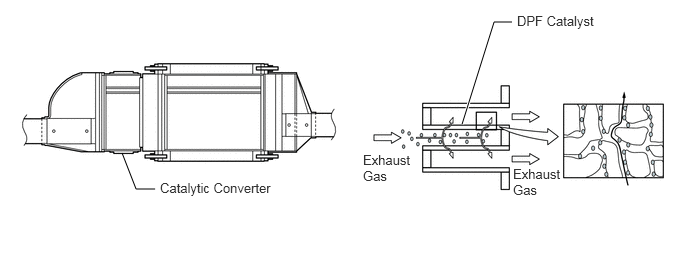
A DPF (Diesel Particulate Filter) catalyst is located in the exhaust pipe. A wall-flow type DPF catalyst, which filters all exhaust gas through ceramic walls with high heat resistance, is used to allow the exhaust gas to be organized by the catalyst when flowing through the porous ceramic structure, reducing PM (Particulate Matter) drastically.
| DTC No. | DTC Detection Condition | Trouble Area |
|---|---|---|
| P2002 | ·
Differential pressure sensor detects abnormally high differential pressure while vehicle is running. ·
Exhaust gas temperature sensor detects abnormally high temperature while vehicle is running. ·
Vehicle is driven continuously without performing forcible regeneration function although DPF switch light is blinking, and amount of accumulated PM exceeds specified value. ·
During forcible regeneration function, temperature of monolithic converter assembly does not increase although injection volume is as specified. (1 trip detection logic) |
·
Exhaust gas temperature sensor ·
Differential pressure sensor assembly ·
Center exhaust pipe assembly (DPF catalytic converter) ·
Open or short in differential pressure sensor assembly circuit ·
Open or short in exhaust gas temperature sensor circuit |
CAUTION / NOTICE / HINT
- NOTICE:
-
After replacing the ECM, the new ECM needs registration (Click here Engine / Hybrid System>N04C-UH (ENGINE CONTROL)>ECD SYSTEM>REGISTRATION) and initialization (Click here Engine / Hybrid System>N04C-UH (ENGINE CONTROL)>ECD SYSTEM>INITIALIZATION).
- HINT:
- ·
Read freeze frame data using the intelligent tester. Freeze frame data records the engine condition when malfunctions are detected. When troubleshooting, freeze frame data can help determine if the vehicle was moving or stationary, if the engine was warmed up or not, and other data from the time the malfunction occurred.
·If the amount of accumulated PM exceeds the specified value, DTC P2002 is set and the system enters fail-safe mode, in which the system limits the engine power.
·Check the amount of engine oil after troubleshooting is finished.
·If the amount of engine oil is more than the specified level, replace the engine oil.
PROCEDURE
Use the table below to troubleshoot each problem symptom.
- Result:
Result Proceed to DPF switch light is blinking A DPF switch light is not blinking B
A
B
Connect the intelligent tester to the DLC3.
Turn the ignition switch to ON.
Turn the tester on.
Enter the following menus: Powertrain / Engine and ECT / DTC.
Read the DTCs.
- Result:
Result Proceed to P2002 A P2002 and other DTCs B
A
B
Connect the intelligent tester to the DLC3.
Turn the ignition switch to ON.
Turn the tester on.
Enter the following menus: Powertrain / Engine and ECT / DTC / P2002.
Read the Freeze Frame Data.
- Result:
Item Exhaust Temperature Proceed to Exhaust Temperature B1S1 Less than 740°C (1364°F) A Exhaust Temperature B1S2 Less than 940°C (1724°F) A Exhaust Temperature B1S1 740°C (1364°F) or more B Exhaust Temperature B1S2 940°C (1724°F) or more C
- HINT:
-
When troubleshooting abnormal temperature detection by exhaust gas temperature sensor (upstream), check that the hose between the turbocharger and the intake manifold is connected properly.
A
B
C
Connect the intelligent tester to the DLC3.
Turn the ignition switch to ON.
Turn the tester on.
Enter the following menus: Powertrain / Engine and ECT / DTC / P2002.
Read the Freeze Frame Data.
- Result:
Item Differential Pressure Proceed to DPF Differential Pressure Less than 15 kPa A 15 kPa or more B
A
B
Click hereEngine / Hybrid System>N04C-UH (ENGINE CONTROL)>ECD SYSTEM>Clogging by DPF Catalytic Converter
Warm up the engine.
Disconnect the negative battery terminal and wait for at least 1 minute.
Reconnect the negative battery terminal.
Initialize the learning value of the supply pump (Click here Engine / Hybrid System>N04C-UH (ENGINE CONTROL)>ECD SYSTEM>INITIALIZATION).
- HINT:
-
Perform initialization with the engine warmed up (engine coolant temperature is 60°C (140°F) or more and fuel temperature is 20°C (68°F) or more).
Initialize the learning value of the diesel throttle body (Click here Engine / Hybrid System>N04C-UH (ENGINE CONTROL)>ECD SYSTEM>INITIALIZATION).
- Result:
Proceed to NEXT
NEXT
Accelerate the engine speed to the maximum rpm with no load 5 times.
Check the volume of black smoke in the exhaust gas.
- HINT:
- ·
If the black smoke is emitted, repeat operation 5 times in a row. When black smoke emission stops within 5 times, it is assumed to be normal.
·If black smoke emission is reduced during the operation, continue revving. When black smoke emission stops, it is assumed to be normal.
·When black smoke emission is not reduced, DPF may be burnt and make a hole, causing soot emission.
·When soot is deposited in the rear side of the exhaust pipe, it may be emitted as black smoke when the engine is revved.
- OK:
Black smoke is not present.
- Result:
Proceed to OK NG
OK
NG
Allow the engine to idle for at least 5 minutes.
Connect the intelligent tester to the DLC3.
Turn the tester on.
Enter the following menus: Powertrain / Engine and ECT / Data List / DPF Differential Pressure.
- HINT:
- ·
If the exhaust gas temperature is high, the differential pressure cannot be measured correctly.
·If the differential pressure is outside the normal range, the monolithic converter assembly may have deteriorated or the monolithic converter assembly may be clogged with PM.
·Fully depress the accelerator pedal and when the engine speed becomes stable, promptly read the differential pressure.
- Result:
Engine Speed (no engine load) Differential Pressure Proceed to 3500 to 3600 rpm (Exhaust gas temperature (up stream) is 200°C or less) 25 kPa or more A Less than 25 kPa B
A
B
Remove the catalytic converter and the monolithic converter.
Blow air to clean the catalytic converter, or soak it in water and wash off the soot.
- NOTICE:
- ·
Make sure to clean both oxidation catalyst and DPF catalyst.
·After installing the catalytic converter, increase idling speed until steam is no longer emitted.
Reinstall the catalytic converter and the monolithic converter.
- Result:
Proceed to NEXT
NEXT
Allow the engine to idle for at least 5 minutes.
Connect the intelligent tester to the DLC3.
Turn the tester on.
Enter the following menus: Powertrain / Engine and ECT / Data List / DPF Differential Pressure.
- HINT:
- ·
If the exhaust gas temperature is high, the differential pressure cannot be measured correctly.
·If the differential pressure is outside the normal range, the monolithic converter assembly may have deteriorated or the monolithic converter assembly may be clogged with PM.
·Fully depress the accelerator pedal and when the engine speed becomes stable, promptly read the differential pressure.
- Result:
Engine Speed (no engine load) Differential Pressure Proceed to 3500 to 3600 rpm (Exhaust gas temperature (up stream) is 200°C or less) Less than 25 kPa A 25 kPa or more B
A
B
Park the vehicle in a safe location.
- NOTICE:
-
Do not leave combustible materials around the exhaust pipe because the temperature of the DPF catalytic converter increases during the forcible regeneration.
Shift the lever to the neutral position.
Securely apply the parking brake.
Warm up the engine.
- HINT:
-
The water temperature is 60°C (140°F) or more.
Connect the intelligent tester to the DLC3.
Turn the tester on.
Enter the following menu items: Powertrain / Engine and ECT / Data List.
Enter the following menus in order and read the values.
Injection Volume
Injection Feedback Val #1 to #4
Exhaust Temperature B1S1
Exhaust Temperature B1S2
Differential Pressure
- Standard:
Item Condition Reference Value Injection Volume Idling (No engine load) 5 to 16 mm3/st Injection Feedback Val #1 Idling (No engine load) -7.0 to 7.0 mm3/st Injection Feedback Val #2 Idling (No engine load) -7.0 to 7.0 mm3/st Injection Feedback Val #3 Idling (No engine load) -7.0 to 7.0 mm3/st Injection Feedback Val #4 Idling (No engine load) -7.0 to 7.0 mm3/st
- HINT:
- ·
If the Injection Volume is out of the Reference Value, check the Injection Feedback Val #1, #2, #3 and #4.
·If any of the Injection Feedback Val #1, #2, #3 and #4 is out of the Reference Value, replace the injector assembly of the corresponding cylinder.
- Result:
Result Proceed to NG B
Perform the forcible regeneration function (Click here Engine / Hybrid System>N04C-UH (ENGINE CONTROL)>ECD SYSTEM>DPF FORCIBLE REGENERATION PROCEDURE).
Read the injection volume, Exhaust Temperature B1S1 and Exhaust Temperature B1S2 during the forcible regeneration function.
- Standard:
Item Condition Reference Value Injection Volume During forcible regeneration function 14 to 21 mm3/st Exhaust Temperature B1S1 During forcible regeneration function 480°C (896°F) or more Exhaust Temperature B1S2 During forcible regeneration function 480°C (896°F) or more
- HINT:
-
Exhaust gas temperature slowly goes up. When it surpasses 200 to 230°C (392 to 446°F), post injection will start and the gas temperature increasing speed will become faster. The gas temperature becomes stable after while.
- Result:
Result Proceed to NG C
After the forcible regeneration is completed, allow the engine to idle for at least 5 minutes.
Enter the following menu items: Powertrain / Engine and ECT / Data List / DPF Differential Pressure.
Check the differential pressure when the exhaust gas temperature sensor indicates 200°C (392°F) or less.
- HINT:
- ·
If the exhaust gas temperature is high, the differential pressure cannot be measured correctly.
·If the differential pressure is outside the normal range, the monolithic converter assembly may have deteriorated or the monolithic converter assembly may be clogged with PM.
·Fully depress the accelerator pedal and when the engine speed becomes stable, promptly read the differential pressure.
- Standard:
Item Condition Reference Value Differential Pressure 3500 to 3600 rpm (Exhaust gas temperature (up stream) is 200°C or less) Less than 15 kPa
- HINT:
-
If the value does not lower than 15 kPa, repeat performing the forcible regeneration one more time. After this, if the value is not lowered than 15 kPa, replace the catalytic converter.
- Result:
Result Proceed to All OK A NG D
A
B
C
D
Replace the ECM (Click here Engine / Hybrid System>N04C-UH (ENGINE CONTROL)>ECM>REMOVAL).
- Result:
Proceed to NEXT
NEXT