2GR-FE ENGINE MECHANICAL ENGINE ON-VEHICLE INSPECTION
PROCEDURE

 1.INSPECT ENGINE COOLANT
Inspect the engine coolant (See page Engine / Hybrid System>2GR-FE COOLING>COOLING SYSTEM>ON-VEHICLE INSPECTION).
2.INSPECT ENGINE OIL
Inspect the engine oil (See page Engine / Hybrid System>2GR-FE LUBRICATION>LUBRICATION SYSTEM>ON-VEHICLE INSPECTION).
3.INSPECT BATTERY
Inspect the battery (See page Engine / Hybrid System>2GR-FE CHARGING>CHARGING SYSTEM>ON-VEHICLE INSPECTION).
4.INSPECT SPARK PLUG
Inspect the spark plugs (See page Engine / Hybrid System>2GR-FE IGNITION>IGNITION COIL AND SPARK PLUG>ON-VEHICLE INSPECTION).
17801
5.INSPECT AIR CLEANER FILTER ELEMENT SUB-ASSEMBLY
Remove the air cleaner filter element sub-assembly.
Visually check that there is no dirt, blockage, and/or damage to the air cleaner filter element.
- HINT:
- ·
If there is any dirt or a blockage in the air cleaner filter element, clean it with compressed air.
·If any dirt or a blockage remains even after cleaning the air cleaner filter element with compressed air, replace it.
6.INSPECT VALVE LASH ADJUSTER NOISE
Rev up the engine several times. Check that the engine does not emit unusual noises.
If unusual noises occur, warm up the engine and idle it for over 30 minutes. Then repeat this procedure.
- HINT:
-
If any defects or problems are found during the inspection above, perform lash adjuster inspection (See page Engine / Hybrid System>2GR-FE ENGINE MECHANICAL>ENGINE UNIT>INSPECTION).
7.INSPECT IGNITION TIMING
Warm up the engine.
When using the intelligent tester:
Check the ignition timing.
Connect the intelligent tester to the DLC3.
Enter DATA LIST mode with the intelligent tester.
- Ignition timing:
8 to 16° BTDC at idle
- HINT:
-
Refer to the intelligent tester operator's manual for help when selecting the DATA LIST.
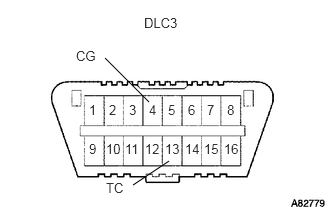
When not using the intelligent tester:
Check the ignition timing.
Using SST, connect terminals 13 (TC) and 4 (CG) of the DLC3.
- SST
- 09843-18040
- NOTICE:
- ·
Confirm the terminal numbers before connecting them. Connection with a wrong terminal can damage the engine.
·Turn off all electrical systems before connecting the terminals.
·Perform this inspection after the cooling fan motor is turned off.
Remove the V-bank cover.
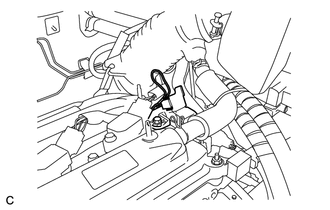
Pull out the red lead wire harness.
Connect the tester terminal of the timing light to the red lead wire as shown in the illustration.
- NOTICE:
-
Use a timing light which can detect the first signal.
Check the ignition timing at idle.
- Ignition timing:
8 to 12° BTDC at idle
- NOTICE:
-
When checking the ignition timing, the transmission should be in neutral.
- HINT:
-
Run the engine at 1,000 to 1,300 rpm for 5 seconds, and then check that the engine rpm returns to idle speed.
Disconnect terminals 13 (TC) and 4 (CG) of the DLC3.
Check the ignition timing at idle.
- Ignition timing:
8 to 16° BTDC at idle
Confirm that the ignition timing moves to the advanced angle side when the engine rpm is increased.
Remove the timing light.
8.INSPECT ENGINE IDLE SPEED
Warm up the engine.
When using the intelligent tester:
Check the idle speed.
Connect the intelligent tester to the DLC3.
Enter DATA LIST mode with the intelligent tester.
- Idle speed:
600 to 700 rpm
- NOTICE:
- ·
When checking the idle speed, the transmission should be in neutral.
·Check the idle speed with the cooling fan off.
·Switch off all accessories and air conditioning before connecting the intelligent tester.
- HINT:
-
Refer to the intelligent tester operator's manual for further details.
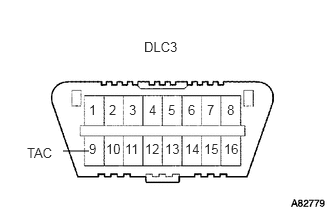
When not using the intelligent tester:
Check the idle speed.
Using SST, connect the tachometer test probe to terminal 9 (TAC) of the DLC3.
- SST
- 09843-18030
Check the idle speed.
- Idle speed:
600 to 700 rpm
9.INSPECT COMPRESSION
Warm up and stop the engine.
Disconnect the injector connectors.
Remove the intake air surge tank (See page Engine / Hybrid System>2GR-FE ENGINE MECHANICAL>ENGINE ASSEMBLY>REMOVAL).
Remove the 6 ignition coils.
Remove the 6 spark plugs.
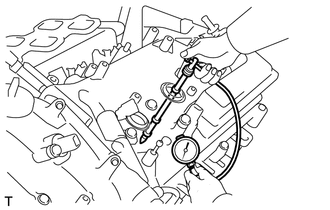
Check the cylinder compression pressure.
Insert a compression gauge into the spark plug hole.
While cranking the engine, measure the compression pressure.
- Compression pressure:
1.3 MPa (13 kgf/cm2, 189 psi)
- Minimum pressure:
0.98 MPa (10 kgf/cm2, 142 psi)
- Difference between each cylinder:
0.1 MPa (1.0 kgf/cm2, 15 psi)
- NOTICE:
- ·
Always use a fully charged battery to obtain an engine speed of 250 rpm or more.
·Check the other cylinders' compression pressure in the same way.
·This measurement must be done as quickly as possible.
If the cylinder compression is low, pour a small amount of engine oil into the cylinder through the spark plug hole and inspect again.
- HINT:
- ·
If adding oil increases the compression, the piston rings and/or cylinder bore may be worn or damaged.
·If pressure stays low, a valve may be stuck or seated improperly, or there may be leakage in the gasket.
Install the 6 spark plugs.
- Torque:
- 18 N*m (184 kgf*cm, 13 ft.*lbf)
Install the 6 ignition coils.
- Torque:
- 10 N*m (102 kgf*cm, 7 ft.*lbf)
Install the intake air surge tank (See page Engine / Hybrid System>2GR-FE FUEL>FUEL INJECTOR>INSTALLATION).
10.INSPECT CO/HC
Start the engine.
Run the engine at 2,500 rpm for approximately 180 seconds.
Insert the CO/HC meter testing probe at least 40 cm (1.3 ft.) into the tailpipe during idling.
Check CO/HC concentration at idle and/or 2,500 rpm.
- HINT:
-
Check regulations and restrictions in your area when performing 2 mode CO/HC concentration testing (engine check both at idle speed and at 2,500 rpm).
-
If the CO/HC concentration does not comply with regulations, perform troubleshooting in the order given below.
Check A/F sensor and heated oxygen sensor operation.
See the table below for possible causes, and then inspect and repair.
| CO | HC | Problems | Causes |
|---|---|---|---|
| Normal | High | Rough idle | 1.
Faulty ignitions: -
Incorrect timing -
Fouled, shorted or improperly gapped plugs 2.
Incorrect valve clearance 3.
Leaks in intake and exhaust valves 4.
Leaks in cylinders |
| Low | High | Rough idle
(fluctuating HC reading) |
1.
Vacuum leaks: -
PCV hoses -
Intake manifold -
Throttle body -
Brake booster line 2.
Lean mixture causing misfire |
| High | High | Rough idle
(black smoke from exhaust) |
1.
Restricted air filter 2.
Plugged PCV valve 3.
Faulty SFI system: -
Faulty fuel pressure regulator -
Defective ECT sensor -
Defective MAF meter -
Faulty ECM -
Faulty injectors -
Faulty throttle position sensor |