1VD-FTV ENGINE CONTROL ECD SYSTEM(w/ DPF) P244C Exhaust Temperature Too Low for Particulate Filter Regeneration Bank 1 P2458 Diesel Particulate Filter Regeneration Duration P2463 Diesel Particulate Filter Restriction - Soot Accumulation
DESCRIPTION
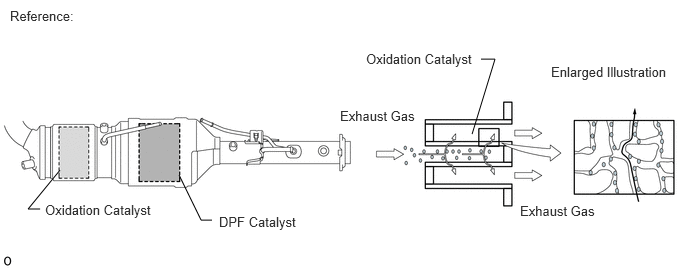
DPF (Diesel Particulate Filter) is an emission control system which processes the particulate matter (PM) that is emitted from a diesel engine. The DPF catalyst has a porous ceramic structure which has a PM collecting function. The PM that is collected is continuously treated by oxidation due to catalytic action at high temperatures, however PM accumulation increases at low catalyst temperatures because the oxidation process slows down. The ECM performs PM forced regeneration so that the amount of accumulated PM does not exceed the threshold.
| DTC No. | Detection Item | DTC Detection Condition | Trouble Area | MIL | Memory |
|---|---|---|---|---|---|
| P244C | Exhaust Temperature Too Low for Particulate Filter Regeneration Bank 1 | During PM forced regeneration, catalyst temperature does not increase sufficiently for 3 minutes. (1 trip detection logic) |
·
Front exhaust pipe assembly (oxidation catalyst)
·
Front exhaust pipe assembly (DPF catalyst)
·
Exhaust fuel addition injector assembly
·
No. 2 exhaust gas temperature sensor
·
No. 3 exhaust gas temperature sensor Common Inspection Item:
·
Fuel injection system
·
Intake/Exhaust system
·
After treatment control system |
Comes on | DTC stored |
| P2458 | Diesel Particulate Filter Regeneration Duration | When PM forced regeneration is manually performed, PM forced regeneration does not finish even after 60 minutes or more elapse. (1 trip detection logic) |
·
Front exhaust pipe assembly (oxidation catalyst)
·
Front exhaust pipe assembly (DPF catalyst)
·
Exhaust fuel addition injector assembly
·
No. 2 exhaust gas temperature sensor
·
No. 3 exhaust gas temperature sensor Common Inspection Item:
·
Fuel injection system
·
Intake/Exhaust system
·
After treatment control system |
Comes on | DTC stored |
| P2463 | Diesel Particulate Filter Restriction - Soot Accumulation | While driving, PM accumulation amount exceeds the limit. (1 trip detection logic) |
·
Front exhaust pipe assembly (oxidation catalyst)
·
Front exhaust pipe assembly (DPF catalyst)
·
Exhaust fuel addition injector assembly
·
No. 2 exhaust gas temperature sensor
·
No. 3 exhaust gas temperature sensor Common Inspection Item:
·
Fuel injection system
·
Intake/Exhaust system
·
After treatment control system |
Comes on | DTC stored |
- HINT:
-
PM forced regeneration may be prohibited due to a fail-safe operation that is performed when another DTC is stored (including engine output limitation).
| DTC No. | Data List |
|---|---|
| P244C |
·
Exhaust Fuel Addition FB
·
Catalyst Differential Press |
| P2458 | |
| P2463 |
CONFIRMATION DRIVING PATTERN
| DTC No. | DTC Detection Drive Pattern |
| DTC Detection Drive Pattern | Engine is running at 4000 rpm with no load for 10 seconds or more. |
MONITOR DESCRIPTION
The ECM monitors the differential pressure between the upstream and downstream of the DPF catalyst and also monitors the exhaust gas temperature to detect a malfunction in the DPF catalyst.
- Excessive PM accumulation:
-
The ECM monitors the PM accumulation ratio and when the accumulated PM volume in the DPF catalyst exceeds the limit, the ECM illuminates the MIL.
- Abnormal catalyst temperature increase:
-
The ECM monitors an exhaust gas temperature increase while the exhaust fuel addition injector assembly adds fuel during PM forced regeneration. The exhaust gas temperature increases up to approximately 300 to 500°C (572 to 932°F) during PM forced regeneration. If the temperature does not increase even after a certain amount of time has elapsed, the ECM determines that the DPF catalyst is abnormal and illuminates the MIL.
- Diesel particulate filter regeneration duration
-
When PM forced regeneration is manually performed and PM forced generation does not finish even after 60 minutes or more elapses, the ECM determines that there is problem with the DPF catalyst converter and illuminates the MIL.
-
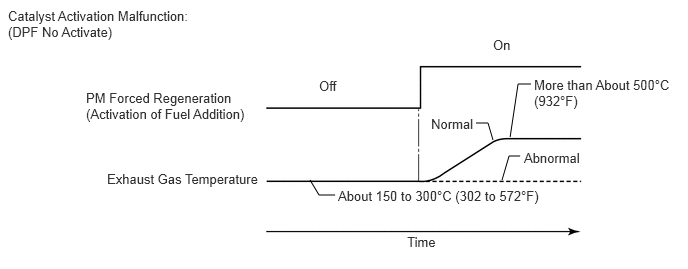 3.229,1.875 3.323,2.031 3.323,2.031 3.49,2.031 false 5.229,1.875 5.302,1.625 5.302,1.625 5.417,1.625 false 5.135,1.458 5.083,1.281 5.083,1.281 4.958,1.281 false 5.313,1.427 5.396,0.875 5.396,0.875 5.531,0.875 false 0.083,0.083 2.021,0.542 1.938,0.458 10 false Catalyst Activation Malfunction: (DPF No Activate) 0.896,0.938 2.573,1.323 1.677,0.385 10 false PM Forced Regeneration (Activation of Fuel Addition) 1.115,1.781 2.74,2.104 1.625,0.323 10 false Exhaust Gas Temperature 3.521,1.958 5.698,2.229 2.177,0.271 10 false About 150 to 300°C (302 to 572°F) 5.458,1.563 6.104,1.771 0.646,0.208 10 false Abnormal 4.49,1.208 4.969,1.417 0.479,0.208 10 false Normal 3.323,0.813 3.646,1 0.323,0.188 10 false Off 5.135,0.385 5.385,0.573 0.25,0.188 10 false On 5.563,0.802 7.01,1.188 1.448,0.385 10 false More than About 500°C (932°F) 4.24,2.438 4.667,2.635 0.427,0.198 10 false Time
CAUTION / NOTICE / HINT
- NOTICE:
-
·
After replacing the ECM, the new ECM needs registration (See page Engine / Hybrid System>1VD-FTV (ENGINE CONTROL)>ECD SYSTEM (w/ DPF)>REGISTRATION) and initialization (See page Engine / Hybrid System>1VD-FTV (ENGINE CONTROL)>ECD SYSTEM (w/ DPF)>INITIALIZATION).
·After replacing the fuel supply pump assembly, the ECM needs initialization (See page Engine / Hybrid System>1VD-FTV (ENGINE CONTROL)>ECD SYSTEM (w/ DPF)>INITIALIZATION).
·After replacing an fuel injector, the ECM needs registration (See page Engine / Hybrid System>1VD-FTV (ENGINE CONTROL)>ECD SYSTEM (w/ DPF)>REGISTRATION).
- HINT:
-
·
If DTC P2458 or P2463 is stored, fail-safe controls engine power output and PM forced regeneration is prohibited. In this case, PM forced regeneration can be performed after disconnecting the EFI MAIN fuse or battery terminal and waiting for 60 seconds or more before connecting it again.
·Read freeze frame data using the GTS. Freeze frame data records the engine condition when malfunctions are detected. When troubleshooting, freeze frame data can help determine if the vehicle was moving or stationary, if the engine was warmed up or not, and other data from the time the malfunction occurred.
PROCEDURE
Connect the GTS to the DLC3.
Turn the ignition switch to ON.
Turn the GTS on.
Enter the following menus: Powertrain / Engine and ECT / Trouble Codes.
- Powertrain > Engine > Trouble Codes
- 50001 61
Record the stored DTC and freeze frame data.
Check Exhaust Fuel Addition FB and Catalyst Differential Press in the freeze frame data.
- HINT:
-
·
When the Exhaust Fuel Addition FB value is 1.45 or more, it indicates a high possibility of insufficient temperature increase during PM regeneration control.
·When the Catalyst Differential Press value is 0.45 or more, it indicates a high possibility that the DPF catalyst is clogged.
- Result:
-
Proceed to NEXT
NEXT
Connect the GTS to the DLC3.
Turn the ignition switch to ON.
Turn the GTS on.
Enter the following menus: Powertrain / Engine and ECT / Trouble Codes.
- Powertrain > Engine and ECT > Trouble Codes
- 50001 234
Read the DTCs.
- Result:
-
Result Proceed to P244C, P2458 or P2463 is output A P244B is output at the same time as P2463* B Other relevant DTCs are output C
- HINT:
-
·
*: When P244B is output at the same time as P2463, perform troubleshooting for P244B.
·When DTC P1603, P1604 or P1608 is output in addition to P244C, perform troubleshooting for P1603, P1604 or P1608 first.
A
B
C
Diagnose relevant DTCs.
Click hereEngine / Hybrid System>1VD-FTV (ENGINE CONTROL)>ECD SYSTEM (w/ DPF)>DIAGNOSTIC TROUBLE CODE CHART
- Result:
-
Proceed to NEXT
NEXT
Start the engine and drive the vehicle until the engine coolant temperature reaches 70°C (167°F) or higher.
Stop the vehicle and allow the engine to idle.
Fully depress the accelerator pedal for 5 seconds, and then release it [A].
Repeat the above procedure [A] 10 times [B].
Check for black smoke emission during procedures [A] and [B].
- OK:
-
Black smoke is emitted less than 5 times.
- HINT:
-
Even if the black smoke is very thin, count the number of black smoke emissions if there is any visible smoke.
- Result:
-
Proceed to OK NG
NG
OK
Connect the GTS to the DLC3.
Turn the ignition switch to ON and turn the GTS on.
Clear the DTCs.
- Powertrain > Engine and ECT > Clear DTCs
- 50002 234
Start the engine and warm it up until the engine coolant temperature reaches 70°C (167°F) or higher.
Perform PM forced regeneration.
Check if excessive white smoke occurs when Exhaust Temperature B1S3 is 300°C (572°F) or more.
- Result:
-
Result Proceed to Excessive smoke occurs during PM forced regeneration (Exhaust Temperature B1S3 is 300°C (572°F)) A Except below B
- HINT:
-
·
When excessive white smoke occurs only during PM forced regeneration, uncombusted fuel that passes through due to the deterioration of DPF catalyst is suspected.
·When combustion control has a malfunction, deterioration or abnormality of driving performance can be felt despite PM forced regeneration being performed.
A
B
Even though it has been determined that the front exhaust pipe assembly (DPF catalyst) needs to be replaced, make sure to perform all diagnostic procedures for DTC P244C, P2458 and P2463 before replacing it.
- HINT:
-
This DTC is stored because an excessive amount of PM has accumulated and resulted in abnormal combustion. It is necessary to diagnose the cause of abnormal PM accumulation and repair the problem. Therefore, do not perform replacement at this time.
- Result:
-
Proceed to NEXT
NEXT
Check the fuel injection system.
Click hereEngine / Hybrid System>1VD-FTV (ENGINE CONTROL)>ECD SYSTEM (w/ DPF)>Fuel Injection System
- Result:
-
Proceed to NEXT
NEXT
Check the intake/exhaust system.
Click hereEngine / Hybrid System>1VD-FTV (ENGINE CONTROL)>ECD SYSTEM (w/ DPF)>Intake/Exhaust System
- Result:
-
Proceed to NEXT
NEXT
Check the after treatment control system.
Click hereEngine / Hybrid System>1VD-FTV (ENGINE CONTROL)>ECD SYSTEM (w/ DPF)>After Treatment Control System
- Result:
-
Proceed to NEXT
NEXT
- HINT:
-
Replace the following items only when it has been determined necessary based on diagnosis for DTC P244C, P2458 and P2463.
Replace the front exhaust pipe assembly (DPF catalyst).
for 5 Door
Click hereEngine / Hybrid System>1VD-FTV (INTAKE / EXHAUST)>EXHAUST PIPE (for 5 Door)>REMOVAL
Except 5 Door
Click hereEngine / Hybrid System>1VD-FTV (INTAKE / EXHAUST)>EXHAUST PIPE (except 5 Door)>REMOVAL
Repair or replace the malfunctioning part confirmed in the diagnosis of the fuel injection system, intake/exhaust system and after treatment control system.
- Result:
-
Proceed to NEXT
NEXT
Connect the GTS to the DLC3.
Turn the ignition switch to ON and turn the GTS on.
Enter the following menus: Powertrain / Engine and ECT / Utility / Catalyst Record Clear.
- Powertrain > Engine > Utility
-
Tester Display Catalyst Record Clear - 50005 234 178
- Result:
-
Proceed to NEXT
NEXT
Connect the GTS to the DLC3.
Turn the ignition switch to ON and turn the GTS on.
Clear the DTCs.
- Powertrain > Engine and ECT > Clear DTCs
- 50002 234
Start the engine and warm it up until the engine coolant temperature reaches 70°C (167°F) or higher.
Perform PM forced regeneration.
- Result:
-
Proceed to NEXT
NEXT